Willemstad Travel Guide
Walk Curacao's capital end to end: the UNESCO old town, candy-colored Handelskade, swinging Queen Emma bridge, keshi yena at the Old Market and Pietermaai at night.
Willemstad is the most photographed place in Curaçao and one of the few Caribbean capitals you can genuinely tour on foot. The historic centre is a UNESCO World Heritage Site, split down the middle by St Anna Bay into two neighbourhoods, Punda and Otrobanda, joined by a floating pontoon bridge that swings open for ships. You can see the headline sights in a focused half-day, but the city rewards a slower pace: a coffee on the Handelskade, a plate of local stew in the Old Market, a sunset cocktail in a restored ruin in Pietermaai. This guide lays out exactly how to walk it, what to see, and the practical details that trip up first-timers.
Why base yourself in Willemstad
Willemstad is the natural first stop on the island. It is central, has the widest choice of hotels and restaurants in Curaçao, and puts you a short drive from both the resort beaches around Jan Thiel and the quiet leeward coves of Bandabou out west. Stay here for two or three nights to do the culture, food and architecture, then move on or day-trip to the sand. For a full tour of the old town with a local guide and tastings along the way, the Willemstad walking food tour is the easiest way to cover Punda and Otrobanda without missing the hidden corners.
The city is genuinely walkable. Distances between the main sights are short, the streets are flat, and the two halves are connected by the bridge. You will not need a car inside the old town. Save the rental for beach days and the far west.
The lay of the land: Punda and Otrobanda
Punda ("the point") is the original 17th-century walled quarter on the east bank, a tight grid of shops, churches and government buildings. This is where most visitors spend their time. Otrobanda ("the other side") sits across the water to the west, grittier and more local, climbing the hillside in a maze of restored townhouses, street art and small galleries. Both are worth your feet. The trick is to cross between them on the bridge rather than treating Punda as the whole city.
The Handelskade: the postcard waterfront
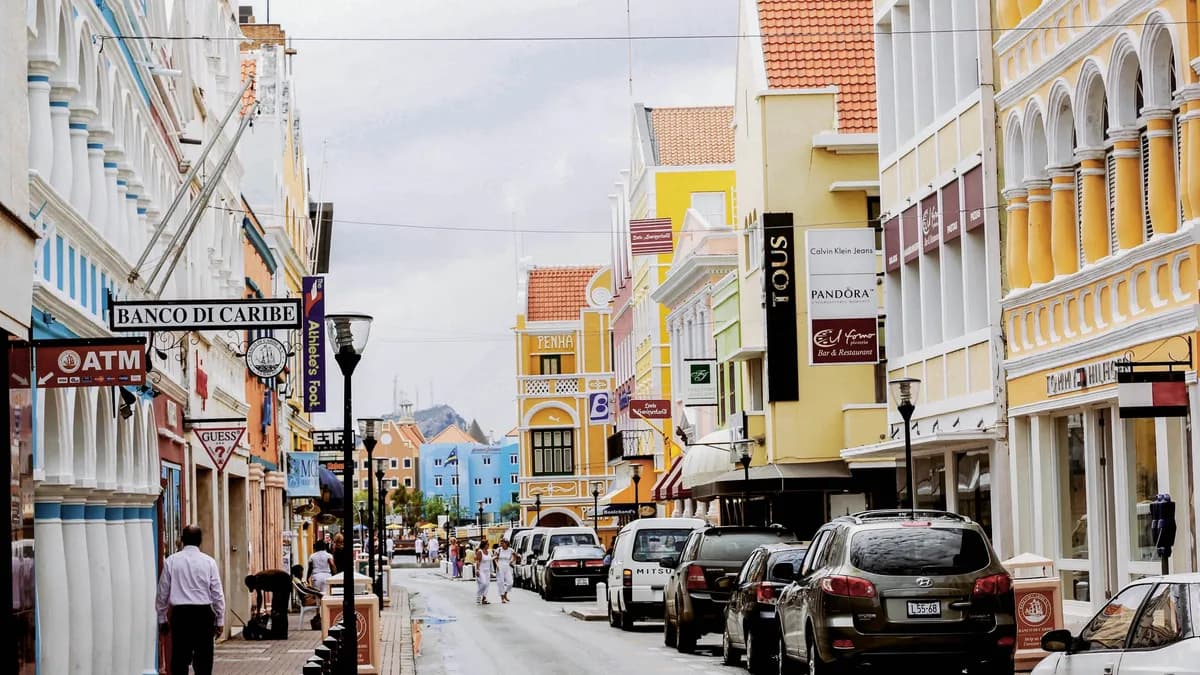
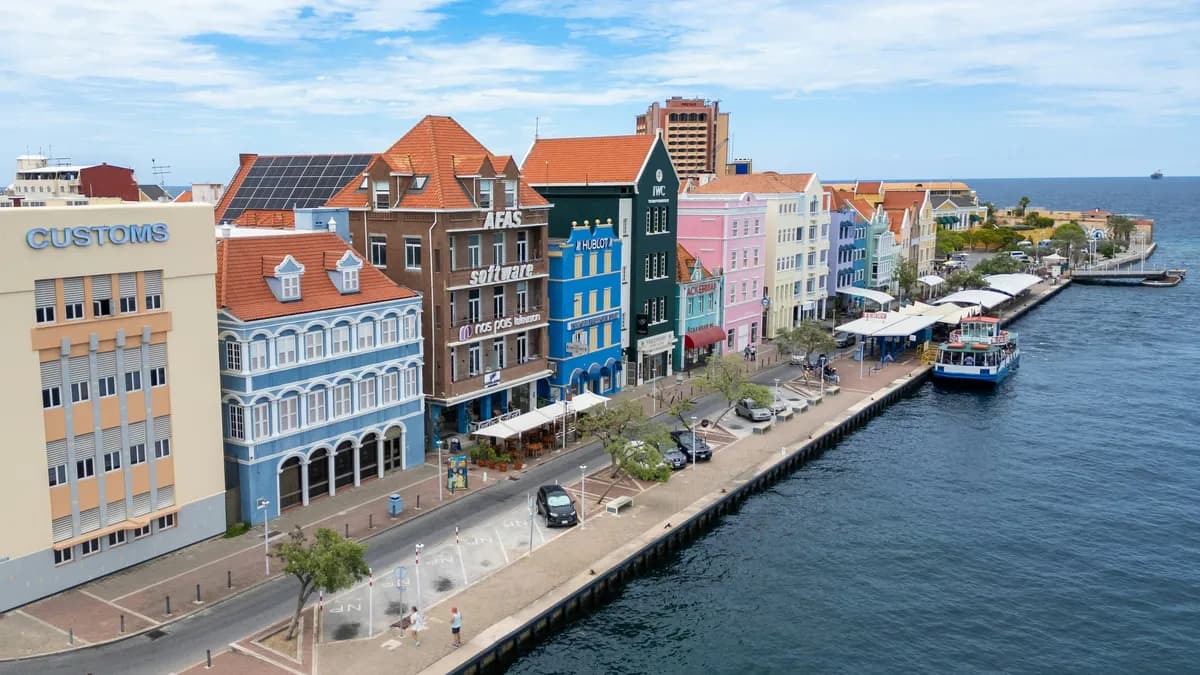
The image that sells Curaçao is the Handelskade, the row of tall, narrow Dutch colonial merchant houses lining the Punda side of St Anna Bay, painted in sherbet shades of ochre, pink, blue and green and mirrored in the harbour. The story locals tell is that a 19th-century governor blamed the glare of whitewashed walls for his headaches and ordered the town painted in colour. True or not, the result is the most distinctive streetscape in the Caribbean.
Come twice if you can: once in the morning when the light hits the facades head-on and the harbour is still, and once at dusk when the buildings are floodlit and the bars fill up. The waterfront promenade behind the houses is lined with cafes; grab a table, order an Amstel Bright, the light lager that was brewed on the island until 2006, and watch the cruise ships ease past just metres away.
Crossing the Queen Emma floating bridge
The Queen Emma Bridge is the single most charming way to get between Punda and Otrobanda. It is a pontoon walkway that floats on the water and swings aside toward the Otrobanda side whenever a ship needs to enter or leave the harbour. Locals call it the "Swinging Old Lady." Crossing is free and takes a couple of minutes.
Here is the catch that surprises everyone: the bridge opens dozens of times a day, sometimes while you are mid-crossing, and stays open anywhere from a few minutes to half an hour. When it swings open, a small free ferry runs between the two banks so you are never stranded. Build a little slack into your plans and treat the opening as part of the show rather than a delay. At night the bridge is strung with lights and is a sight in itself.
The floating market and the Old Market
Walk along the Punda waterfront on the inner harbour (the Waaigat) and you will reach the floating market, a line of boats that have crossed roughly 60 km of open sea from Venezuela to sell tropical fruit, vegetables and fish straight off the deck. It is a working market, busiest in the morning, and a reminder of how close the South American mainland really is. Photograph respectfully and buy something if you stop.
A short walk inland, the Old Market (Plasa Bieu) is a no-frills hall where cooks serve up the island's everyday food at communal tables. This is the place to try keshi yena, the national dish of spiced meat baked inside a shell of Edam or Gouda cheese, a delicious leftover of the island's Dutch-trader past. Expect goat stew, fried fish, funchi (cornmeal polenta) and fresh juice, all at local prices. Cash in small bills is handy here.
Fort Amsterdam and the synagogue
At the tip of Punda, Fort Amsterdam is the 17th-century heart of the city and still the seat of the Curaçao government. You can walk into the courtyard and visit the Fortkerk, the fort church, which has an old cannonball lodged in its wall from a 19th-century bombardment. Much of the complex is working offices, so be respectful, but the open areas are free to wander and give you the original Dutch West India Company layout.
A couple of blocks away stands the Mikve Israel-Emanuel synagogue, the oldest synagogue in continuous use in the Americas, dating to 1732. Its most famous feature is the floor: it is covered in white sand, a tradition with several explanations, from muffling the footsteps of worshippers who once had to hide their faith to symbolising the desert of the Exodus. A small museum on site tells the story of the Sephardic Jewish community that helped build Willemstad's trade. Dress modestly and check opening times, as it closes for services.
Otrobanda and the Kura Hulanda museum
Cross the bridge to Otrobanda for a different mood. The streets here are quieter, the architecture more lived-in, and the murals more contemporary. The standout is the Kura Hulanda Museum, an unflinching and important museum on the transatlantic slave trade and African heritage, built around a restored merchants' courtyard. It is one of the most substantial museums in the Dutch Caribbean and well worth an hour or two. Pair it with a slow wander through the surrounding alleys, which are full of small bars and craft shops.
Pietermaai: the nightlife district
Just southeast of Punda, Pietermaai is the city's reinvention story. Once a crumbling 18th-century quarter, it has been restored into Willemstad's nightlife and boutique-hotel district, with rooftop bars, restaurants and cocktail spots tucked into candy-painted ruins. By day it is sleepy; from late afternoon it comes alive. This is where most visitors eat dinner and end the night, with everything from Caribbean small plates to international kitchens within a short walk. It is also a pleasant place to stay if you want to roll out of bed and into the old town.
A taste of blue: the Curaçao liqueur distillery
No trip to the capital is complete without tracking down the source of that famous electric-blue spirit. At Landhuis Chobolobo, just east of the centre, the Curaçao liqueur distillery still makes the original liqueur from the dried peel of the laraha, a bitter local citrus descended from sweet oranges Spanish settlers introduced, which turned bitter in the island's arid soil. The blue colour is purely cosmetic; the liqueur also comes clear, orange, green and red. A short tour and tasting at the historic mansion is an easy add-on. If you would rather make a half-day of it, book the dedicated blue Curaçao distillery tour.
Easy add-ons near the city
Willemstad works as a launchpad. A few minutes east of Pietermaai, the Curaçao Sea Aquarium and the city beaches at Mambo Beach give you sand and a swim without leaving town. Continue a touch further and you reach the calm cove of Jan Thiel Beach, the busiest beach-club strip on the island. For the famous postcard coves, set aside a full day and drive west to Cas Abao or the twin Playa Kenepa Grandi, around 45 minutes from the capital.
If you would rather stay in the water, Curaçao is one of the world's great shore diving destinations, with reefs you can swim to straight from the beach. Snorkeling with turtles at Playa Grandi and a Klein Curaçao day trip to the uninhabited islet southeast of the island are the two excursions most visitors book from a Willemstad base. Nature lovers should keep a day for Christoffel National Park in the far west.
Getting around Willemstad on foot (and the practicalities)
Inside the old town, walking is the only sensible option, and the most enjoyable. The two halves are joined by the Queen Emma Bridge (free) with the backup ferry when it swings open. Wear comfortable shoes; the historic streets are uneven in places.
- No Uber. There is no Uber or ride-hailing app on Curaçao. Getting around outside the centre means a rental car, the Konvoi public buses, or taxis with fixed fares.
- Taxis are unmetered and run on government-set fixed rates by zone. Agree the fare before you get in. Fares can rise after about 11pm and for larger groups, so confirm first.
- Currency. The local money is the Caribbean (Netherlands Antillean) guilder, written ANG or NAf and called the "florin" locally, pegged at roughly 1.79 NAf to one US dollar. US dollars are accepted almost everywhere and most card payments are fine, so you rarely need to change money. Keep small bills for the markets and parking.
- Driving is on the right. If you rent a car, the airport is about 15 to 20 minutes from the centre.
- Tap water is safe. Curaçao's tap water is desalinated seawater and safe to drink, so skip the bottled water.
- Language. Papiamentu is the everyday language, but Dutch, English and Spanish are all widely spoken, so ordering and asking directions is easy.
A suggested walking day
Start with coffee on the Handelskade in the morning light, then cross the Queen Emma Bridge to explore Otrobanda and the Kura Hulanda Museum. Cross back, browse the floating market, and have lunch at the Old Market. Spend the early afternoon on Fort Amsterdam, the Fortkerk and the Mikve Israel-Emanuel synagogue, then walk over to Pietermaai. Finish with the distillery tasting if you have the legs for it, and circle back to the waterfront for sunset and dinner in Pietermaai. That single loop covers the UNESCO core, and you will have done almost all of it on foot.
Frequently Asked Questions
Is Willemstad walkable?
Yes. The UNESCO old town is compact and flat, and the two halves, Punda and Otrobanda, are linked by the free Queen Emma floating bridge. You can see the Handelskade, the floating market, Fort Amsterdam, the synagogue and Pietermaai on foot in a single day. You only need a car for beaches and the far west of the island.
How does the Queen Emma Bridge work?
It is a floating pontoon footbridge that swings aside toward the Otrobanda side to let ships pass in and out of the harbour. Crossing is free. When it opens, sometimes while you are mid-crossing, a small free ferry shuttles people between the two banks, so you are never stranded. Allow a little extra time, because it can stay open from a few minutes up to around half an hour.
What currency is used in Willemstad and do they take US dollars?
The local currency is the Caribbean (Netherlands Antillean) guilder, written ANG or NAf and called the "florin," pegged at roughly 1.79 NAf to one US dollar. US dollars are accepted almost everywhere and cards are widely taken, so most visitors never need to exchange money. Carry small bills for markets, taxis and parking.
How do I get from the airport to Willemstad?
Curaçao International Airport (Hato, code CUR) is roughly 15 to 20 minutes by car or taxi from the city centre. There is no Uber on the island, so use a fixed-fare taxi (agree the price before you set off) or pick up a rental car. Driving is on the right.
What is the must-try food in the old town?
Head to the Old Market (Plasa Bieu) in Punda for keshi yena, the national dish of spiced meat baked inside a shell of Dutch cheese, plus goat stew, fried fish and funchi at communal tables and local prices. For the sweet side, taste the original Curaçao liqueur at the Landhuis Chobolobo distillery.
Is Willemstad safe to walk at night?
The main visitor areas, the Handelskade, Punda and Pietermaai, are generally relaxed and well used in the evening, especially Pietermaai which is the nightlife district. As in any city, stick to lit, busy streets, keep valuables out of sight, and take a fixed-fare taxi rather than walking alone through quiet back streets late at night.
Willemstad
This guide covers Willemstad. Explore more about this destination.
View DestinationAbout the Author
Alex Borshch
Founder and editor of the Isla365 network. Spent six months living in the Dominican Republic over the 2013-14 winter, and has since wintered in Thailand, Vietnam and Turkey. Writes and edits the guides across the network.