Getting Around Curaçao
How to get around Curaçao without Uber: when a rental car beats taxis for the southwest beaches, fixed-fare taxi rules, Konvoi buses, and airport drive times.
Here is the honest truth most Curaçao guides bury: the island rewards people who can drive themselves. The calm, postcard beaches of the southwest, the cactus-lined back roads of Bandabou, and the cliff coves you actually want to swim at are scattered far from the bus routes. Get your transport plan right and the whole island opens up. Get it wrong and you will spend your trip stuck near the resort strip, waiting on taxis that cost more than you expected.
This guide walks through every realistic way to move around Curaçao: renting a car (you drive on the right), the Konvoi public buses, the island's fixed-fare taxis, how far things actually are from the airport, the little water ferries that cross Willemstad's harbour, and the local driving quirks nobody warns you about. There is no Uber here, so a quick read now saves real money and hassle later.
The quick version: what to use, and when
Curaçao is about 60 km long and surprisingly spread out for a Caribbean island. A few simple rules cover most trips:
- Rent a car if you want to reach the great southwest beaches, the national parks, or anywhere in Bandabou (the rural western half). This is the single best decision most visitors make.
- Use taxis for the airport run, a night out in Willemstad, or short hops around Jan Thiel when you do not want to drive after a drink.
- Use the Konvoi buses if you are on a tight budget and staying near Willemstad, and you are relaxed about timing.
- Walk plus water taxi inside Willemstad itself, where the historic centre is compact and split by a harbour channel.
One reassuring note before you plan: Curaçao sits south of the hurricane belt, so the weather is warm, dry, and stable almost year-round. You rarely have to build your transport plan around storms, which makes self-driving low-stress.
Renting a car: your ticket to the real island
If you take one thing from this guide, take this: a rental car transforms a Curaçao trip. The leeward (south and west) coast hides a string of calm, clear-water beaches that public transport simply does not serve, and the only practical way to string several together in a day is your own wheels.
Drive on the right
Curaçao drives on the right-hand side of the road, the same as the United States and continental Europe, with the steering wheel on the left. If you are used to that, there is almost nothing to relearn. Road signs follow the Dutch/European style, distances are in kilometres, and speeds are in km/h. Seatbelts are required, and as anywhere, do not drink and drive.
What it costs and what to know
Daily rental rates are moderate and very reasonable when split between two or more people, especially compared with stacking up taxi fares. A few practical pointers:
- Book ahead in high season (roughly December to April and during local events). Stock tightens and walk-up rates rise.
- You can pay in US dollars almost everywhere. The local currency is the Caribbean guilder (Cg, ISO code XCG; also called the florin), which replaced the former Netherlands Antillean guilder (NAf) in 2025, pegged at roughly 1.79 to one US dollar, but dollars and cards are accepted by the major agencies.
- A small SUV or crossover earns its keep if you plan to reach Christoffel National Park, Shete Boka National Park, or the rougher tracks down to beaches like Playa Jeremi and Playa Kenepa Grandi. Main roads are paved, but the last stretch to wild beaches and park trails can be unpaved and bumpy.
- Fuel up before heading west. Petrol stations cluster around Willemstad and the populated southeast; they thin out fast in Bandabou.
A driving day that actually works
To picture why a car matters: from Willemstad you can breakfast in town, drive west to snorkel at Playa Porto Mari or Cas Abao, push on to the twin coves of Kenepa Grandi and Kenepa Chiki, then loop up to Playa Forti near Westpunt for a sunset. That itinerary is effortless with a car and nearly impossible without one.
Distances from the airport and around the island
Curaçao International Airport (Hato, code CUR) sits on the north coast (near the Hato Caves) and has one of the longest runways in the Caribbean, which is why so many long-haul flights land here. From the terminal, plan for roughly:
- Willemstad city centre: about 15 to 20 minutes by car (the harbour and Punda/Otrobanda are close in).
- Jan Thiel and the southeast resort area: roughly 25 to 30 minutes.
- Westpunt and the far western tip: closer to 45 to 60 minutes, depending on traffic and stops.
The island is small enough that even a cross-island drive is manageable in a morning, but Curaçao is wider than first-timers expect, so do not assume the western beaches are a quick hop from a southeastern hotel.
Taxis: fixed fares, agreed up front
There is no Uber, Lyft, or Bolt on Curaçao, so taxis fill that gap. The good news is that fares are not random: Curaçao uses a system of government-set fixed rates between zones rather than meters. The catch is that you should always confirm the price before you get in, ideally pointing to your destination on a map.
- Confirm the fare first and agree whether the quoted price is in US dollars or guilders, since both circulate. This avoids any end-of-ride surprises.
- Surcharges apply at night (typically late evening onward), on Sundays, and on public holidays, and there may be a small charge per extra passenger or for large luggage. Ask if any apply.
- Licensed taxis are marked and often have a "TX" element on the plate. Your hotel or a beach-club host can call a reliable driver if none are waiting.
- For a full beach day, some drivers will quote an hourly or half-day rate to wait and shuttle you. For multiple stops this is usually pricier than a rental car, so compare before committing.
Taxis shine for the airport transfer with luggage, for a dinner in Willemstad when you would rather not park, and for late nights out around Jan Thiel and Mambo Beach.
Konvoi buses and minibuses: the budget option
Curaçao's public transport runs on two layers. The large government buses, locally called Konvoi, run scheduled routes radiating from the two main bus stations in Willemstad: one in Punda and one in Otrobanda, on the two sides of the harbour. Alongside them, smaller privately run minibuses and vans (look for a "BUS" sign on the plate) cover many of the same corridors more frequently but less predictably.
- Fares are low, which makes buses the cheapest way to move if you are based near the city. Carry small change; pay the driver.
- Routes favour residential and town corridors, not tourist beaches. You can reach Willemstad neighbourhoods and some larger towns, but the remote southwest coves are effectively off the network.
- Timing is relaxed. The smaller minibuses tend to leave when reasonably full and may not run to a strict timetable, so build in patience and do not rely on them after dark.
- To flag a minibus, wave it down from the roadside; to get off, signal the driver in advance.
Buses are a fine way to get between your guesthouse and central Willemstad for sightseeing, but if your plan involves Playa Grandi, Playa Lagun, or a national park, a car or taxi will save you a frustrating day.
Getting around Willemstad: walk, ferry, and the swinging bridge
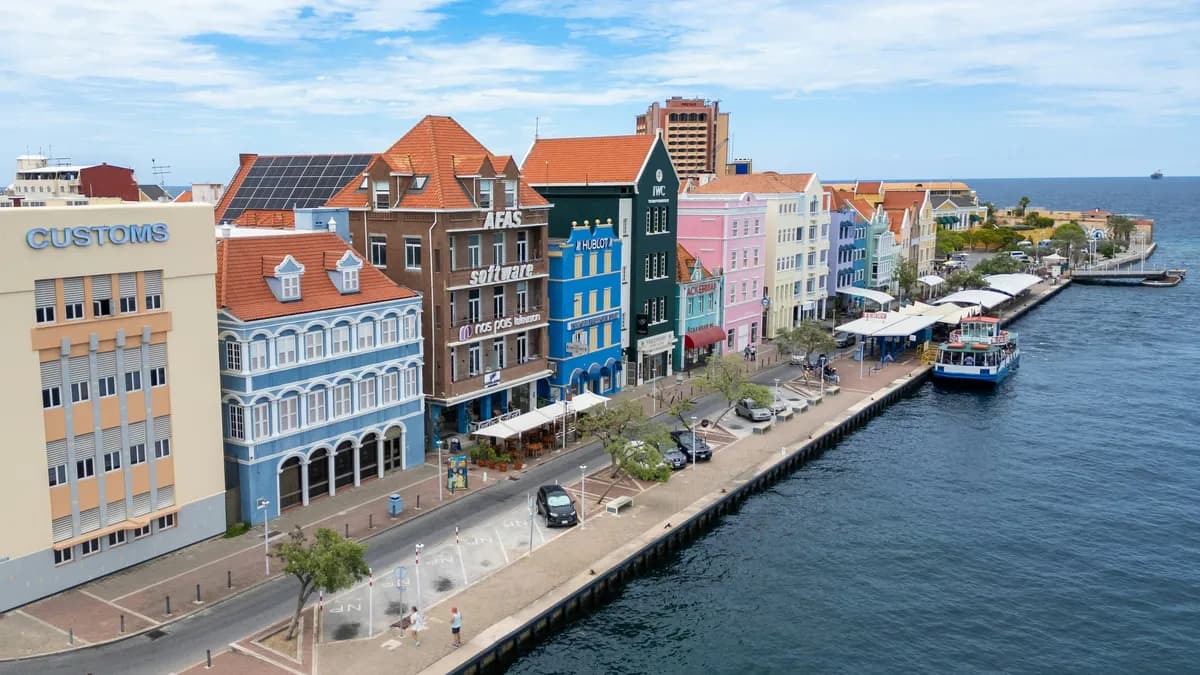
The UNESCO-listed heart of Willemstad is split by St Anna Bay into two halves: Punda on the east and Otrobanda on the west. Once you are in the centre, the best way around is on foot, and crossing between the two sides is half the fun.
- The Queen Emma Bridge is a floating pontoon footbridge that physically swings open to let ships pass. When it is open, walking across is not possible, which is where the water taxi comes in. See Queen Emma Bridge for the story behind this island icon.
- Free pedestrian ferries shuttle people across the harbour channel whenever the bridge swings open for marine traffic, so you are never stranded on one side. These little boats are the original Willemstad "water taxi".
- On foot you can string together the colourful waterfront, the historic Fort Amsterdam, and the Mikvé Israel-Emanuel Synagogue in a single easy morning. A guided Willemstad walking food tour is a great way to learn the lanes while you nibble your way around.
Parking in central Punda fills up fast. If you are driving in, aim for a lot on the Otrobanda side or near the cruise terminal and walk across, rather than circling the narrow one-way streets of Punda.
Getting to the water: harbour hops and Klein Curaçao
Some of Curaçao's best "getting around" is by boat. Within Spanish Water, the protected lagoon at Spanish Water is the launch point for many sailing trips and the gorgeous uninhabited islet of Klein Curaçao, reached on an organised Klein Curaçao day trip rather than scheduled ferry. For a gentler outing, a sunset catamaran sail doubles as transport and entertainment. None of these replace a car for daily logistics, but they are the right "vehicle" for reaching places no road goes.
Local driving tips that save the day
Curaçao driving is straightforward, but a few island specifics are worth knowing before you turn the key:
- Watch for free-roaming animals. In Bandabou and near the parks, goats, iguanas, and the occasional donkey wander onto the road. Slow down on blind curves.
- Unpaved last miles are normal. The road to many wild beaches and to Shete Boka National Park turns to dirt or rock near the end. Drive slowly; a higher-clearance car helps.
- Roundabouts (rotondes) are everywhere. Traffic already on the circle has priority. Signal when you exit.
- The north (windward) coast is wild. Roads there are quieter and the surf is rough; this is not a swimming coast, so plan stops at viewpoints, not beaches.
- Carry water and sun protection. The interior is hot, dry, and cactus-studded, with long stretches between shops. Tap water is safe and desalinated, so refill a bottle before you set off.
- Keep some small cash. A few beaches and farms charge a modest entry or parking fee, sometimes payable only in cash; dollars or guilders both work.
Put it together and the formula is simple: rent a car for the freedom to chase the southwest's calm beaches and the wild west, lean on fixed-fare taxis for nights out and the airport, treat the Konvoi buses as a budget backup near town, and walk plus ferry your way around historic Willemstad. Do that and Curaçao feels twice as big and half as complicated.
Frequently Asked Questions
Do you need a car in Curaçao?
You do not strictly need one if you plan to stay around Willemstad and the nearby resort areas and are happy using taxis and buses. But to reach the best southwest beaches such as Cas Abao, Playa Porto Mari, and the Kenepa coves, plus the national parks, a rental car is by far the easiest and most cost-effective option, since public transport does not serve those spots well.
Is there Uber in Curaçao?
No. There is no Uber, Lyft, or similar ride-hailing app on Curaçao. Instead the island uses licensed taxis with government-set fixed fares between zones. Always agree the price before you get in, and confirm whether it is quoted in US dollars or guilders.
Which side of the road do you drive on in Curaçao?
You drive on the right-hand side of the road, the same as the United States and continental Europe, with the steering wheel on the left. Road signs follow the European style, and distances and speed limits are posted in kilometres.
How far is the airport from Willemstad?
Curaçao International Airport (Hato, code CUR) is roughly 15 to 20 minutes by car from central Willemstad. The southeast resort area around Jan Thiel is about 25 to 30 minutes away, while the far western tip near Westpunt is closer to 45 to 60 minutes.
Can I use US dollars to pay for transport in Curaçao?
Yes. The local currency is the Caribbean guilder (Cg, ISO code XCG; also called the florin), which replaced the former Netherlands Antillean guilder (NAf) in 2025, pegged at roughly 1.79 to one US dollar, but US dollars and cards are widely accepted for car rentals and taxis. Carry some small bills or coins for bus fares and the occasional beach or parking fee.
Are the public buses in Curaçao reliable for tourists?
The large Konvoi buses and smaller minibuses are cheap and fine for getting between Willemstad neighbourhoods and larger towns, but they favour residential routes rather than tourist beaches and can run on relaxed, sometimes unpredictable timetables. They work best as a budget option near the city; for remote beaches and parks, a car or taxi is more dependable.
Willemstad
This guide covers Willemstad. Explore more about this destination.
View DestinationAbout the Author
Alex Borshch
Founder and editor of the Isla365 network. Spent six months living in the Dominican Republic over the 2013-14 winter, and has since wintered in Thailand, Vietnam and Turkey. Writes and edits the guides across the network.