Curaçao Shore Dive Sites: 38 Walk-In and Boat Trips
More than 38 shore sites line the calm south coast. Which ones you can walk into, which need a boat (Mushroom Forest, Watamula, Blue Room), and tank logistics.
Curaçao has more than 38 recognized shore diving sites strung along its calm southern coastline, and more than half of the island's total dive sites are reachable without ever setting foot on a boat. That mix of easy walk-in entries and genuine wreck and reef diving is why divers arrive with a rental truck instead of a boat charter.
The short version: rent tanks and weights from a local dive shop, load them into a pickup, and drive the south coast on your own clock. No boat crew, no fixed departure times. A few famous sites are the exception: Mushroom Forest and Watamula are boat-access only, and the Blue Room is usually visited by boat, so plan those separately.
Why Curaçao works so well for shore diving
Curaçao sits about 12 degrees north of the equator, outside the Atlantic hurricane belt, so conditions stay reliable year-round. The bigger factor is geography: the southern (leeward) coastline acts as a natural windbreak, keeping shore-entry conditions calm and manageable for a diver in full gear walking off a beach or down a set of steps.
The north (windward) coast is a different world entirely. Limestone cliffs sit on volcanic rock, high waves roll in from the open ocean, and tradewinds keep the surface rough. It's not suited to recreational diving, and virtually all diving on the island, shore or boat, happens on the sheltered south side. That's also where the island's most walkable beaches are.
Water temperature averages about 27°C (81°F) year-round, visibility typically runs 20 to 30 meters (65 to 100 feet), and currents are usually mild: exactly the conditions that make a spontaneous, no-boat dive plan realistic rather than a gamble.
The marquee shore dives
The Tugboat
If Curaçao has a signature shore dive, this is it. The wreck sits at Tugboat Beach in Caracas Bay (Caracasbaai) in just 5 meters (15 feet) of water, wrecked only a few yards offshore, so entry is an easy walk-in followed by a short swim. The tug sank more than 30 years ago and sits fully intact, covered in sponge and coral growth, shallow enough for beginners, snorkelers, and photographers. The adjacent reef slope drops to about 30 meters (100 feet) for divers who want more. Look for seahorses, octopus, lobsters, napping scorpionfish, and the odd nudibranch. It belongs on every Curaçao dive itinerary.
Director's Bay
Director's Bay sits between the Tugboat and Small Wall and carries real history: from the early 1900s until 1985 it was reserved for directors of the Royal Dutch Shell Group and the Dutch Royal family. It's open to everyone now. Local legend says one section was caged off for Queen Juliana, said to be very afraid of sharks; the structure decaying on the seafloor, now encrusted in coral and sponge, is actually an old surge-protection device, but the legend endures.
Entry is via concrete steps down from the parking area. The bottom is rocky at the entry point, so water shoes or dive booties are worth packing, and while there's enough parking at the site, it's a secluded spot, so don't leave valuables visible in the vehicle. Depth ranges from about 6 to 36 meters (20 to 120 feet), which makes it workable for both diving and snorkeling, and Scuba Do accepts Scuba Diver certification for supervised dives. Reef Renewal Curaçao has out-planted more than 15,000 corals along the island's southeastern coastline, including several out-planting structures right at Director's Bay, so there's a live restoration project to spot mid-dive.
Playa Lagun
Playa Lagun has one of the easiest shore entries on the island: a sandy beach with minimal surf and current, parking close to the water, and no fee to use the area. The drop-off begins roughly 150 to 200 meters from the beach at about 10 meters of depth, then slopes at close to 45 degrees down to around 30 meters. Turtles, spotted eagle rays, moray eels, lobsters, and reef squid all show up regularly, and pods of bottlenose dolphins occasionally join divers and snorkelers.
The Superior Producer
For certified divers ready to go deeper, the MV Superior Producer is Curaçao's best-known wreck dive. The ship sank on 30 September 1977, just three hours after casting off from Willemstad, loaded with a Christmas cargo of whisky, perfume, clothing (including a large shipment of blue jeans), and bags bound for Venezuela. It capsized and now rests roughly 150 meters (500 feet) offshore, about 500 meters west of the harbor entrance.
The wreck sits upright on an even keel in about 30 meters (100 feet) of water, with its shallowest point around 22 meters (72 feet), which puts it beyond recreational Open Water depth limits. Advanced Open Water certification, or the equivalent, is required. It can be dived from shore or by boat, but shore divers must run an inflated surface marker buoy (SMB) because of the site's position near Willemstad's harbor channel. One more logistics note: diving is not allowed when cruise ships or other vessels are moored at the adjacent Curaçao Mega-piers 1 and 2, so check the berthing schedule (the CPA Cruise App is one way to do it) before planning the dive.
Turtle etiquette at Playa Piskado
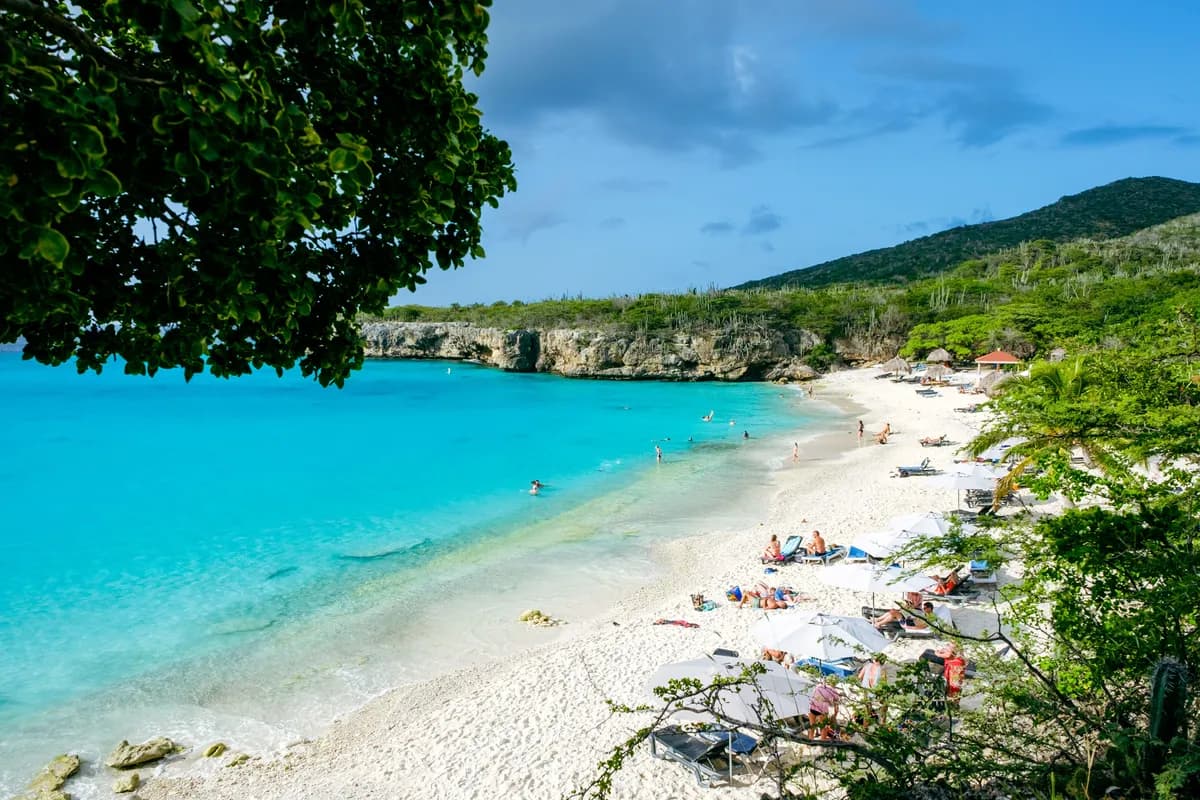
Playa Piskado, also known as Playa Grandi, sits on the northwest side of the island near Westpunt and is Curaçao's famous turtle beach. "Piskadó" means "fisherman" in Papiamentu, and the name explains the draw: sea turtles gather here because fishermen returning with their catch discard fish scraps into the water, and the turtles learned the spot pays off.
That history is exactly why etiquette matters here. Keep at least 2 meters (6 feet) of distance. Never touch or attempt to ride a turtle, since human contact can damage the mucus layer that protects their skin, raising infection risk and adding stress the animal doesn't need. Never feed them either: feeding disrupts natural foraging behavior and builds a dependency on humans.
This isn't just etiquette, it's law. All sea turtle species are legally protected in Curaçao under a 1996 island decree (Eilandsbesluit bescherming zeeschildpadden), which confers complete protection on marine turtles in the island's territorial waters and inland bays. Catching or harming one is illegal. Before you go, read our broader notes on snorkeling with turtles.
Where shore diving stops and the boat starts
Not everything is reachable from the beach, and knowing which sites need a boat saves you from forcing an entry that doesn't exist.
Mushroom Forest, on the remote northwest coast near Santa Cruz Bay, is boat-access only. It's named for enormous star coral formations that have grown upward and outward over centuries into giant mushroom-like shapes, and it consistently ranks among the island's top dive sites.
The Blue Room, a partially submerged sea cave near Mushroom Forest where sunlight through the entrance fills the cave with glowing blue light, is usually visited by boat, often paired with a Mushroom Forest dive on the same outing. There is technically a no-boat option: strong swimmers in calm conditions can kayak in or hike from Playa Santa Cruz and swim the final stretch, but it isn't a casual shore entry.
Watamula, between the island's western tip and its northern point just past Westpunt, is boat-access only. Shore entry here is unsafe and not recommended. The site is known for alternating bands of hard and soft coral, with depths commonly running 6 to 36 meters (20 to 120 feet). Dive operators sell two-tank guided boat trips that combine Watamula, Mushroom Forest, and the Blue Room into a single outing to the island's west and northwest sites.
How the logistics actually work
Curaçao has no mandatory dive permit, dive tag, or marine-park nature fee, which sets it apart from neighboring Bonaire, where the STINAPA Nature Fee runs $40 USD per person per calendar year and is required for any water activity in the Bonaire National Marine Park (children under 12 are exempt). Some individual Curaçao beaches do charge their own entrance fee. Cas Abao Beach, for example, charges around $6.00 per car Monday through Saturday and $7.00 on Sundays, public events, and holidays, covering up to four people per car with roughly $1.40 for each additional person; the beach is open daily from 8:00am to 6:00pm.
Independent shore divers typically rent tanks and weights a la carte. The Dive Shop Curaçao, for instance, rents an air tank with weights for $12, offers a full gear set for $50 per 24 hours, sells an Unlimited Air Package, and runs a 24/7 dive locker so renters aren't tied to shop hours. The Dive Bus runs a similar model under its Independent Diver packages: a one-tank guided dive on the house reef on day one to confirm gear survived the flight, weighting is correct, and divers know the shop's safety and eco policies, followed by independent diving on your own schedule. The shop also partners with National Car Rental for discounted rates, with a minimum five-day rental. "Sleep, Drive & Dive" packages, bundling accommodation, unlimited air fills, and a rental vehicle, are an established, named product for exactly this style of self-guided trip.
For comparison, a guided one-tank afternoon boat dive with a major operator like Ocean Encounters starts at $90 per person including tank and weights, with Open Water certification as the minimum requirement. That gap, $12 for a shore tank versus $90 for one guided boat dive, is the financial case for shore diving across a multi-dive week.
Certification and skill-level notes
Open Water certification is the baseline for independent diving with a buddy; supervised introductory dives are available without certification. Advanced Open Water certification qualifies divers to 30 meters (100 feet); deeper dives require further training. Scuba Do requires Advanced Open Water for the Superior Producer. Depths vary widely by site: the Tugboat sits in just 5 meters and suits newer divers comfortably, while Director's Bay and Watamula both extend down to 36 meters (120 feet).
A starting list of shore sites
Beyond the sites above, a commonly cited top-10 list of Curaçao shore dives includes Alice in Wonderland (Playa Kalki), the Tugboat, Cas Abao, Porto Mari, Kokomo Beach, Playa Lagun, Director's Bay, Blue Bay Wall, Double Reef, and the Airplane Wreck in Santa Martha Bay.
| Site | Depth range | Access | Best for |
|---|---|---|---|
| The Tugboat | 5m to ~30m (15-100ft) | Shore, easy walk-in | Beginners, photography |
| Director's Bay | 6-36m (20-120ft) | Shore, concrete steps | Open Water divers, snorkelers |
| Playa Lagun | ~10m to ~30m | Shore, sandy entry | Turtles, one of the easiest entries |
| Superior Producer | 22-30m (72-100ft) | Shore (SMB required) or boat | Advanced Open Water divers |
| Mushroom Forest | Varies | Boat only | Giant coral formations |
| Watamula | 6-36m (20-120ft) | Boat only | Hard and soft coral bands |
The overall pattern is simple: the walk-in sites line the sheltered southern coast, while the headline boat-only sites, Watamula and Mushroom Forest among them, sit off the island's west and northwest. A trip that mixes both, a few days of independent shore diving followed by one boat trip out to Watamula, Mushroom Forest, and the Blue Room, covers the island's range without paying boat prices for sites you could have walked into. Check current conditions and beach fees with a local operator before you go, since pricing gets revisited from year to year. For more planning help, see our west coast beaches guide and the broader activities section.
About the author
Alex Borshch
Keep reading
Related articles
Newsletter
Enjoyed this article?
Sign up for our newsletter to receive more travel tips, insider guides, and exclusive offers. No spam, just one thoughtful email a month.
We respect your privacy. See our Privacy Policy.