Best Time to Visit Curaçao: No Direct Hurricane Since 1877
Curaçao sits at 12°N, on the southern fringe of the hurricane belt, where direct impacts are rare. Month by month on rain, prices, and why October is the underrated pick.
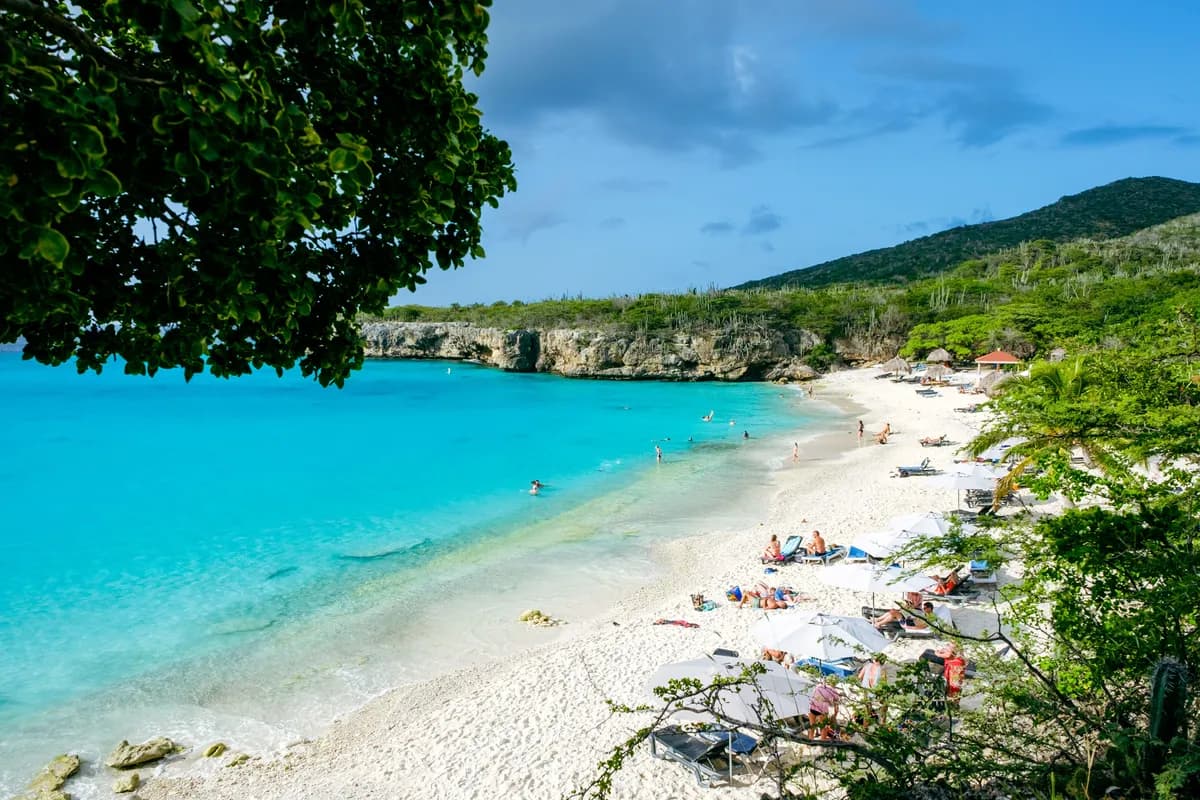
The best time to visit Curaçao is largely whatever your budget allows, because the island sits at roughly 12°N latitude, south of the main Atlantic hurricane corridor, and its weather barely changes month to month. There is no real "hurricane season" to plan around here the way there is across much of the Caribbean. What shifts across the calendar is price, crowds, and a short, mild rainy stretch from October through January, while rare storms can still disrupt a trip.
That southern position, away from where Atlantic hurricanes form and track, is Curaçao's biggest advantage over most of the region. You can book September, October, or November, typically the cheapest, quietest months, without the storm anxiety that hangs over islands farther north. Below: a month-by-month breakdown of weather, rain, price, and events, plus why late September and October deserve more attention than they usually get.
Why Curaçao barely has a hurricane season
Curaçao lies about 65 km (40 miles) north of the Venezuelan coast, part of the ABC islands (Aruba, Bonaire, Curaçao) in the Dutch Caribbean. At roughly 12°N, it sits outside the Main Development Region where most Atlantic tropical cyclones form, so storms track across the Atlantic well to the north and typically curve away long before reaching the island.
The numbers back this up. According to Curaçao's Meteorological Department, 37 or more tropical cyclones passed within 100 nautical miles of the island between 1605 and 2024, an average of roughly one every 11 years, and no hurricane has made landfall since the U.S. National Hurricane Center began modern tracking. A hurricane passed just south of Curaçao on September 23, 1877, a storm known locally as Hurricane "Tecla" or "Orkan Grandi" (Papiamento for "big hurricane"), which caused about $2 million in damage and at least 70 deaths on the island, with winds around 105 mph and accounts of solid Willemstad buildings crushed "as if they were things of paper." That is nearly a century and a half ago.
None of this makes Curaçao immune. The official Atlantic hurricane season still runs June 1 to November 30, peaking August to October, and the island can catch outer rain bands, gusty winds, or a burst of heavy rain from a distant system. Direct hits are historically rare, not impossible. But the practical difference is real: travelers to islands inside the hurricane belt spend June through November watching storm trackers, while Curaçao visitors are mostly deciding between sun and a slightly rainier version of sun.
Curaçao's actual seasons
Per Curaçao's Meteorological Department, the year splits into a dry season from February through May, a rainy season from October through January, and July through September as transitional months. Locals describe it more informally as rainy, windy, and hot summer, three loose stretches rather than four sharp seasons, which says a lot about how little the climate actually swings. The prevailing trade winds blow from the east and east-northeast. The climate is officially classified as semi-arid (Köppen BS), within the Southern Caribbean Dry Zone, far from a lush, rain-soaked tropical climate.
Rain: short, local, mostly overnight
Even in the wetter months, rainfall stays modest. Official annual totals were 623.2 mm in 2021, 772.5 mm in 2022, 661.4 mm in 2023, and 367.7 mm in 2024, low but variable, consistent with commonly cited long-term averages of roughly 450 to 600 mm. Rainy days ranged from 60 to 95 per year across that stretch. Within the wetter months specifically: roughly 91 mm in October, about 141 mm in November (the wettest month), and about 86 mm in December, with no month averaging more than roughly 141 mm at Hato in the 1991–2020 normals. The pattern matters more than the totals: showers are usually heavy but short and local, falling mostly at night and blowing over quickly. Days of continuous rain are very rare, so a trip booked in the "wet" months rarely loses a beach day.
Temperature and sea conditions, year-round
Temperatures barely move across the calendar. Official average air temperatures ranged from 27.6°C to 29.1°C over 2021-2024. The 1991–2020 monthly averages at Hato run from about 26.7°C in January, the coolest month, to 29.3°C in September, the warmest, with typical daytime highs of 30-33°C (86-91°F). Humidity averages around 78% year-round, from roughly 77% in the least humid months to about 80% in November. The sea is just as steady, averaging about 27°C year-round, dipping to roughly 25.9°C in February and March and warming to about 28.2°C in September and October, warm enough to swim in comfortably every month. Curaçao also gets more than 3,000 hours of sunshine a year, roughly 8 to 10 hours a day.
Month-by-month guide
| Month | Weather | Price and crowds | Notable events |
|---|---|---|---|
| January | Rainy season; light showers | High season, peak pricing | Carnival season opens Jan 3; royalty elections, Tumba festivals |
| February | Dry season begins; sea coolest (~25.9°C) | High season, peak pricing | Carnival parades build to Grand Parade Feb 15; season closes Feb 21 |
| March | Dry, low rainfall | Tail of high season | Post-Carnival calm |
| April | Dry, stable and sunny | High season fading | King's Day, Apr 27; Seú harvest parade on Easter Monday |
| May | Dry season | Shoulder pricing begins | Quiet month |
| June | End of dry season | Low season, better rates | Atlantic hurricane season begins Jun 1 (largely irrelevant here) |
| July | Transitional | Secondary peak, busier | Quiet month |
| August | Transitional, sea warming | Secondary peak, busier | North Sea Jazz sometimes falls late August |
| September | Warmest air (29.3°C at Hato), sea near peak | Cheapest stretch begins | North Sea Jazz, Sept 3-5, 2026; coral spawning dives |
| October | Rainy season begins, ~91 mm rain | Cheapest, quietest month | Coral spawning dives continue; calm seas |
| November | Wettest month, ~141 mm rain | Cheapest fares and rates of the year | Quiet month |
| December (to ~20th) | Rainy season, ~86 mm across the month | Festive but still lower-priced | Early holiday build-up |
| December (after ~20th) | Rainy season continues | Peak holiday pricing and crowds | Christmas and New Year peak |
January and February: Carnival and high season together
Dry-season weather arrives while Carnival is in full swing, and prices sit at their yearly high, a combination running mid-December through April. The 2026 Carnival season officially opens January 3 and closes with an awards ceremony on February 21. Royalty elections and the Tumba festivals (crowning the season's anthem) run through January, then February brings the Children's and Teen Parades, the Grand Carnival Parade or "Gran Marcha" through Willemstad on Sunday, February 15, and the illuminated Marcha di Despedida on February 17, the eve of Ash Wednesday, when an effigy of King Momo is burned at midnight to close the season. Book well ahead if you want the parades.
March and April: dry, calm, and King's Day
With Carnival behind it, the island settles into its driest, most reliable stretch. April brings King's Day (Koningsdag) on the 27th, celebrating King Willem-Alexander's birthday with orange-clad street parties centered on Willemstad's Punda and Pietermaai districts, plus the Seú harvest parade (Marcha di Seú) every Easter Monday; the 2026 edition drew thousands of participants across 40 groups. High season pricing typically holds through April.
May and June: quietly excellent value
Low season pricing begins as high season fades, with hotel rates that may be lower than during peak periods. Weather is still dry, the sea is warming toward its September-October peak, and June 1 marks the official start of Atlantic hurricane season, a date that matters far more to islands north of Curaçao than to Curaçao itself.
July through September: transitional and warming
This stretch sits between the dry and rainy seasons. Air temperatures peak here, with September averaging 29.3°C at Hato, and sea temperatures climb toward their own high of about 28.2°C. Late August or early September brings the Curaçao North Sea Jazz Festival, founded in 2010 partly to boost low-season tourism; the 2026 edition runs September 3-5 with a lineup including J Balvin, Jon Batiste, Toto, Rubén Blades, and The Jacksons. Outside festival dates, this stretch grows quieter and cheaper as September progresses.
October: the underrated month
October is when the rainy season technically begins, with average rainfall around 91 mm, but showers are typically heavy, short, and concentrated overnight, so daytime plans rarely get disrupted. September through November are the cheapest and quietest months of the year, with the lowest airfares, hotel rates, and crowds. October is also prime time for coral-spawning dives, clustered in the nights following the August-through-October full moons with dives timed to enter the water before the predicted spawning time for the target species, with calm seas making conditions ideal. The month brings the year's peak thunderstorm activity, about 7 thunderstorm days on average, but that is a burst-and-clear pattern, not a wash-out. For near-peak sea temperatures, real savings, and one of the best dive calendars on the island, October is hard to beat, and it is consistently overlooked by travelers who assume "Caribbean rainy season" means the same everywhere. It does not here.
November and December: still cheap, then suddenly not
November averages roughly 141 mm of rain, the year's highest, and carries the highest average humidity at about 80%. Prices and crowds stay at their yearly low through the month, and the rain keeps to the same overnight pattern as the rest of the season. December splits in two: early December, before roughly the 20th, is festive but still lower-priced; once the Christmas-New Year peak begins around the 20th, prices and crowds rise sharply. Average rainfall for the month sits around 86 mm.
Planning around evening showers and flamingo season
Because showers in the October-to-January stretch mostly fall at night, planning around them is less about avoiding months and more about structuring days. Front-load beach time and outdoor activities for daylight hours, and treat evenings as flexible. A walk through Willemstad works well after a shower has passed, when the harbor facades look freshly washed, and the beaches in our west coast beaches guide sit on the side of the island facing away from the easterly trade winds.
Flamingos can be seen most of the year at the protected salt flats (saliña) of Jan Kok near Sint Willibrordus, a free spot viewable from the road with no tour required, though flock numbers peak roughly December through April. Best daily viewing is early morning, around 6:30 to 7:30 am and generally before 11 am, or around sunset; the birds move between salt flats, so sightings are never guaranteed.
How to choose your window
If your priority is the best chance of dry weather and you do not mind peak prices and crowds, aim for the dry season, February through May, or the festive January-to-mid-February stretch if Carnival is part of the draw. If your priority is value, book September through November, when fares and hotel rates are lowest and the "rainy season" label undersells how little it interferes with a normal day. The sweet spot between the two is late September into October: warm air, warm sea, calm diving conditions, falling prices, and rain that mostly happens while you sleep.
Whichever window you pick, remember what makes Curaçao different from most of the Caribbean: it sits south of the hurricane corridor, so the calendar you are really navigating is mainly one of price and rainfall intensity, with a low but real risk of storm disruption. Our 7-day Curaçao itinerary and broader itineraries section build in this seasonal logic, and the destinations and beaches guides help match a coastline to whichever month you land.
About the author
Alex Borshch
Keep reading
Related articles
Newsletter
Enjoyed this article?
Sign up for our newsletter to receive more travel tips, insider guides, and exclusive offers. No spam, just one thoughtful email a month.
We respect your privacy. See our Privacy Policy.